SAP Cloud ERP Private
Keep your existing assets, but first decide what stays and what goes.SAP Cloud ERP Private is the route that keeps continuity with your existing SAP environment while moving to the S/4HANA data model and cloud infrastructure. Because your organisation controls upgrade timing and the scope of extensions, it suits companies whose industry-specific processes and long-accumulated development assets are a real competitive edge. ECHOIT is an SAP Silver Partner that has implemented and run SAP ERP since 2008, with more than 1,000 implementation and operations references.
Continuity, though, does not come from moving alone. Move without deciding what to keep and what to clear out, and the technical debt comes with you into the cloud. What follows is how to structure that decision.
Three conditions that put SAP Cloud ERP Private first in the review
Premise 1. Industry specificity
Processes the standard cannot replaceWhere regulatory or industry requirements have shaped processes that standard scenarios alone cannot carry.
- Regulatory basis
- audit requirements
- whether a substitute exists
Premise 2. Asset continuity
Development assets built up over yearsWhere custom developments and interfaces run for years have hardened into working knowledge of the business.
- Object usage history
- judgement on what must be kept
Premise 3. Control
Control over upgrade timing and scopeWhere upgrade timing has to be set around the business calendar, such as closing periods and peak season.
- Business calendar
- test resources
- release policy
SAP ERP maintenance timeline
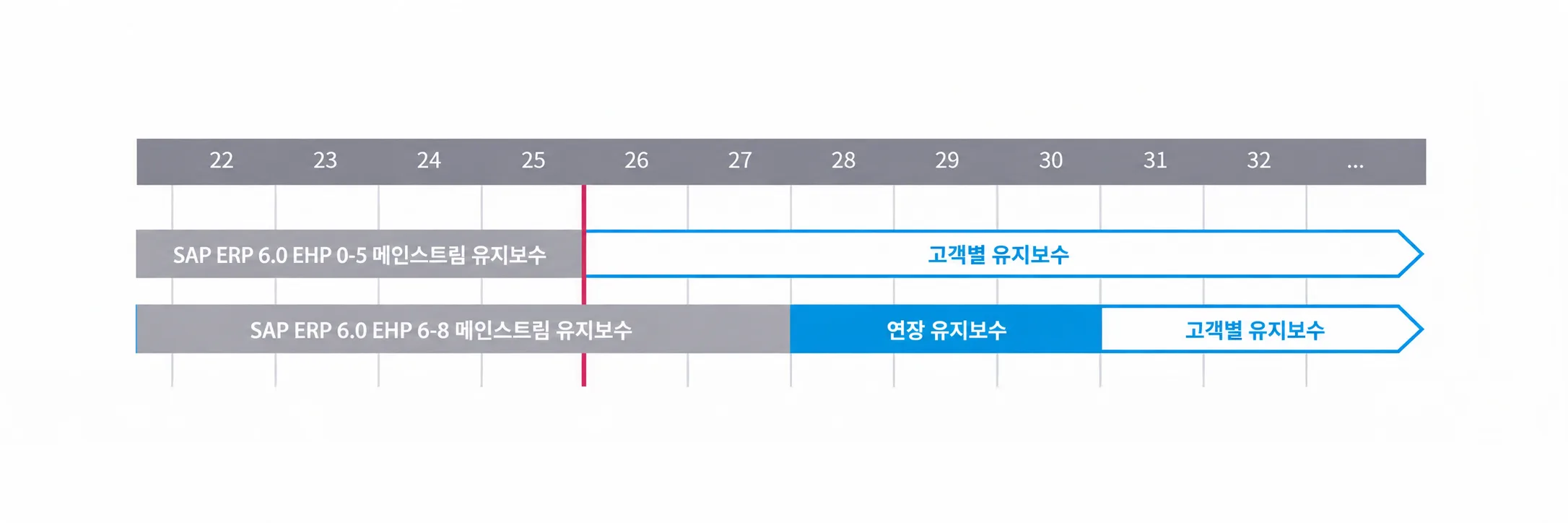
How to read the maintenance timeline
EHP 0–5
Mainstream maintenance has ended; these run under customer-specific maintenance.
EHP 6–8
Mainstream maintenance runs to the end of 2027, with optional extended maintenance available for 2028–2030. After that they move to customer-specific maintenance.
Extended maintenance is optional for 2028–2030. Customers who do not take it move to customer-specific maintenance from 2028.
Markings beyond 2031 do not indicate an end date. Separate transition programmes and exceptions are confirmed per contract.
Source: support.sap.com · Maintenance 2040 / checked 2026-09-10
Checking the risks after end of support, item by item
The severity shown is an example of conversation priority, not the result of assessing your system.
Gaps in support for security and legal changes
Delay in securing migration people and dates
Extension costs and accumulating technical debt
Compatibility of surrounding products and interfaces
The migration approach is settled realistically among three options
Brownfield, selective data transition, and greenfield are not ranked against each other. The state of your current system and your go-live constraints narrow which are possible, and the decision is made by comparing cost and risk among what remains.
Brownfield — system conversion
Convert to S/4HANA while keeping the current configuration, data, and custom development. Business disruption is relatively short and there is less to redesign, but configuration errors and unused custom code accumulated in the old system can travel with it. How much cleanup happens before the conversion therefore decides how the project goes.
Selective data transition
Move only the company codes, processes, and periods you need into the new environment. It suits migrating some entities first, or redefining accounting standards while carrying only part of the history. The freedom comes at a price: the design for verifying data consistency has to be the most rigorous of the three, and specialist tools and verification scenarios are essential.
Greenfield — new build
Redefine processes against the standard and migrate master data and balances. It cuts off accumulated debt, but it asks the most of the organisation in agreeing to the standard and in change management. Even in SAP Cloud ERP Private it is a valid choice when redefining processes is the point.
| Decision axis | Greenfield | Brownfield | Selective Data Transition |
|---|---|---|---|
| Process | Redesigned around the standard | Current processes continue | Choose what stays and what changes |
| Data | Migrate only what is needed | Convert existing data | Select by entity and period |
| Custom code | Replace with standard or rebuild | Compatibility analysis and fixes | Reuse only the assets needed |
| Downtime | Designed through migration and cutover | Measured in conversion rehearsals | Split strategy and consistency checks |
| Organisational change | Change management matters most | Focus on the scope of impact | Parallel running and boundary control |
| Fits companies that | Are new to ERP or standardising group-wide | Put continuity of ECC assets first | Are splitting, merging, or migrating in part |
Use the wider extensibility, but manage the complexity
SAP Cloud ERP Private supports both a new build and the migration of an existing system. The clean core principle is the same as in Public, but wider extension options and existing development assets have to be weighed together. So we separate the extensions that carry business value from the technical debt to be cleared, and manage impact analysis and test scope against the company's upgrade plan.
Existing development is judged as keep, replace, or improve
When migrating an existing SAP ERP, rather than carrying development and integrations across as they are, we judge them on business value, whether a substitute exists, risk, and cost of ownership. Genuinely distinctive functionality moves into ERP-internal extensions or onto SAP BTP, while direct modifications and unsupported access are cleared in stages.
Clean core criteria differ by migration route
A new build designs standard-led processes and extension rules from the start. An existing-system migration judges current assets as keep, replace, improve, or separate, and records the reasoning and when to revisit it. Both routes prepare impact analysis and a test regime aligned to the company's upgrade plan.
| Area | What Private focuses on | The question at migration and in operations |
|---|---|---|
| Business processes | Apply the standard, single out distinctive work | What should be standardised, and which differences are worth keeping? |
| Extensions | Assess existing development, in-ERP extensions, and BTP | Which extensions do we keep, replace, or separate? |
| Data | Manage migration scope, quality, and retention rules | Which data moves, and which gets cleared? |
| Integration | Risk of existing interfaces, move to standard APIs | Can direct connections be changed to the standard approach? |
| Operations | Impact analysis and testing against the company plan | Is the verification scope defined for each upgrade? |
Migration risk is handled as assessment items, not as a feeling
The sense that migration is risky usually comes from experience rather than evidence. ECHOIT turns that sense into measurable items along five axes, separating what is genuinely risky from what is manageable. The results feed straight into the choice of migration approach and the schedule estimate.
Custom code
ATC checks combined with usage history keep only the objects actually in use and size the work to fix them.
- object decision sheet
Data
Volume, quality, retention periods, and accounting consistency are checked to fix the migration scope.
- migration design
Interfaces
Integration methods and business criticality are classified to identify what must be rebuilt at migration.
- interface inventory
Testing
A regression set is defined around core business flows, and the scope of automation is agreed.
- test scenarios
Operational readiness
The allowable cutover window, the authorisation model, and operational roles are fixed in advance.
- cutover plan
Each of the five axes leaves its own deliverable, and while any one of them is unfinished the migration approach is not fixed.
Migration experience, described by scope and conditions
This is a published template, shown before delivery data is received. It is not to be read as actual cases or results.
Migration of ECC production and costing
Migration of orders, inventory, and logistics
Migration of finance and management accounting
Frequently asked questions about migration
End of support and migration approach both depend on your particular system and contract terms.
It is not a shutdown date. It is the end of mainstream maintenance for the Business Suite 7 applications concerned, after which the support model and its cost need to be confirmed.
See the ECC maintenance timelineThe end-of-support date depends on the product you run today and on your contract terms. Pin down your system version and migration constraints first, then check the timeline in the SAP Cloud ERP Private review.
See the ECC maintenance timelineThe end-of-support date depends on the product you run today and on your contract terms. Pin down your system version and migration constraints first, then check the timeline in the SAP Cloud ERP Private review.
See the ECC maintenance timelineA greenfield build on standard processes points to Public; continuity with existing ECC assets points to Private. The edition follows from the assessment of your current system and how far your organisation can adopt the standard.
See how to choose an editionWe analyse how custom code is actually used and what it affects, then sort it into keep, replace, or retire. The standard core stays protected, and the extensions you still need are reviewed as side-by-side options such as BTP.
See the clean core approachA greenfield build on standard processes points to Public; continuity with existing ECC assets points to Private. The edition follows from the assessment of your current system and how far your organisation can adopt the standard.
See how to choose an editionBegin by setting out your current system, process scope, target timeline, and organisational constraints. Work through the checklist in the decision guide, and anything still open can be worked out together in conversation.
Request a consultationBegin by setting out your current system, process scope, target timeline, and organisational constraints. Work through the checklist in the decision guide, and anything still open can be worked out together in conversation.
See the risk assessmentSet the next step against your current assets and migration constraints
Assess the migration risk, or compare it with a standard-led new implementation.